
Somewhere in Day 5, I stopped looking like a trail runner and started looking like a kid whose mom dressed him for a blizzard he didn’t want to go out in.
Rain pants. Rain jacket. Buff yanked up over my nose. Gloves. Not one square centimeter of skin left exposed to the wind, which had decided, with no warning and no apology, to turn the Bartang Valley into a dusty swirl with a personal vendetta.
I looked absurd. I felt like I was eight years old. And right there, somewhere inside that exact combination of ridiculous and miserable, I chucked a small wooden nugget into the wind and felt something in my chest unclench that I hadn’t even noticed was clenched in the first place.
We’ll come back to the nugget.
The Unrace
The Great Silk Run is a foot crossing of Tajikistan’s Gorno-Badakhshan Autonomous Oblast, GBAO, start to finish. Seven days, 170+ miles by my watch, 21,000+ feet of cumulative elevation gain. From the Afghan border through the Bartang river valley, up onto the high Pamirs, and finishing near Karakul and the Chinese border. Mountains stacking up on every other side like the landscape was showing off.
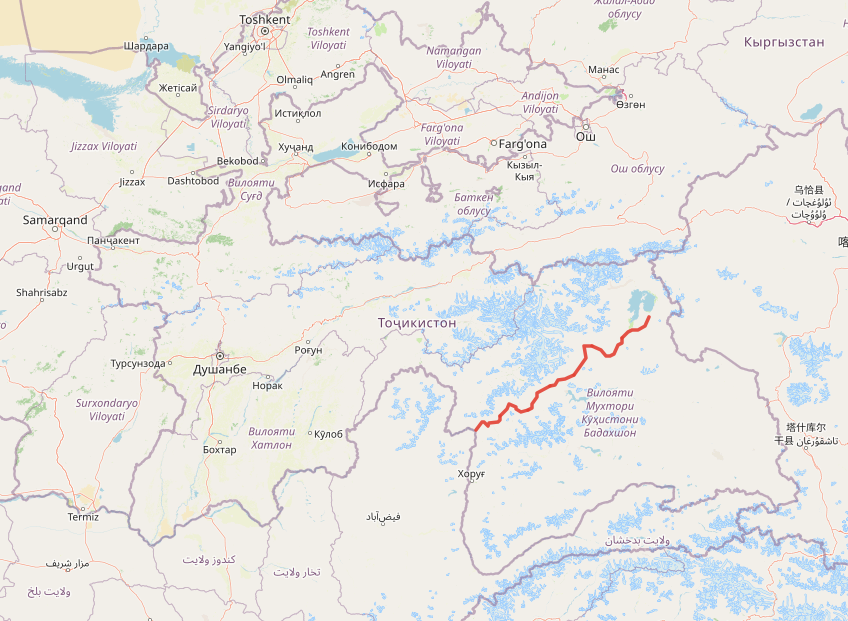
It calls itself an “unrace.” No timing chips. No results table. No winner, no loser. Just thirty-some people moving on foot through one of the most remote and geopolitically loaded stretches of the planet, supported by a fleet of jeeps, medics, vibe makers, and a Bluetooth speaker the size of a small refrigerator.
The unrace framing matters more than it sounds. Most running events hand you something external to chase: a time, a place, a podium. Take all that away and you’re left holding a question that’s harder than any finish line. Namely: what are you actually out here for?
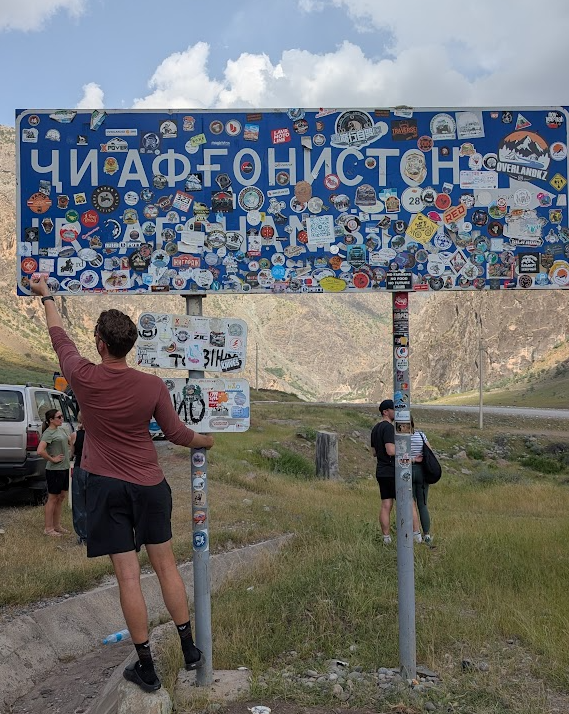
I like to organize my adventure reflections around Maslow’s hierarchy: five tiers running from Survival up through Safety, Community, Esteem, and Transcendence. It’s a taxonomy for why anyone willingly signs up for hard, uncertain, uncomfortable experiences. The GSR doesn’t just brush against all five tiers. It marches you up every one of them, in order, ready or not. What follows is a picture of what each tier actually looks like on the ground.
Survival: The Body Keeps Its Own Ledger
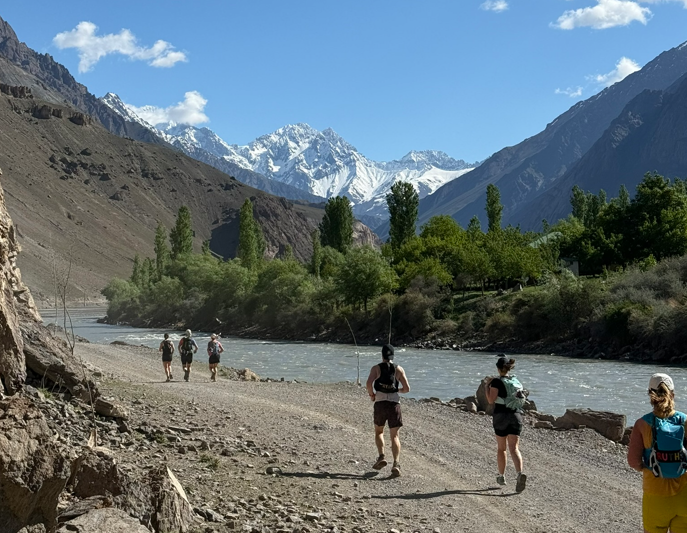
Every day on the GSR runs the same shape. Three legs. Snack camp after the first, lunch camp after the second, and after the third, wherever you’re sleeping that night. Mostly homestays in local villages, two nights in tents. Eat breakfast, run, repeat until you run out of Tajikistan to cross.
By the numbers, the days average just over 24 miles and 3,000 feet of cumulative climbing, though the distribution is anything but even. Days 1 and 2 ease you in at a modest 1,900 feet of gain each. Day 5 ambushes you with 4,327 feet and nearly 11 hours of moving time, the day the route climbs off the valley floor and onto the high plateaus. Your legs will know the difference.
Food is abundant in the caloric sense. Rice, soup, bread, and then for variety, more rice. Some mornings, eggs. The macros are where things get complicated. Protein ranges from insufficient to nonexistent, which over seven days of serious output stops feeling like a dietary preference and starts feeling like an ongoing hostage negotiation with your own muscles. For my expedition, two meals broke through the blur of lukewarm starch and lodge themselves permanently in memory: a goat dinner at the last homestay before the first night in tents, and pancakes with sausage during a later day’s breakfast. Both felt like dispatches from a more civilized civilization.
Sleep is communal. Homestays split the men and women into shared rooms: mats on the floor, blankets or sleeping bags, everyone breathing the same air. Ear plugs are not optional equipment, they are load-bearing infrastructure. The two camping nights introduce a different set of variables. Tent assignments vary by size, the altitude makes itself felt through your sleeping bag more than you expect, and if your air mat decides to quietly deflate over the course of several hours, you will spend the remainder of the night on cold ground conducting an inventory of every rock beneath you.
Then there’s altitude. The route climbs gradually and then all at once. The Bartang valley is low and hot. The back half of the trip pushes past 12,000 feet onto the high Pamirs, and that elevation has firm opinions about whether it wants you there. Altitude medication comes up in conversation before the start. Whether you take it is a personal call, but the possibility is worth considering before you’re three days in and your stomach is staging a revolt. Hydration is the unglamorous first line of defense and it works more reliably than it has any right to.
Safety: Scarier on Paper Than on the Ground
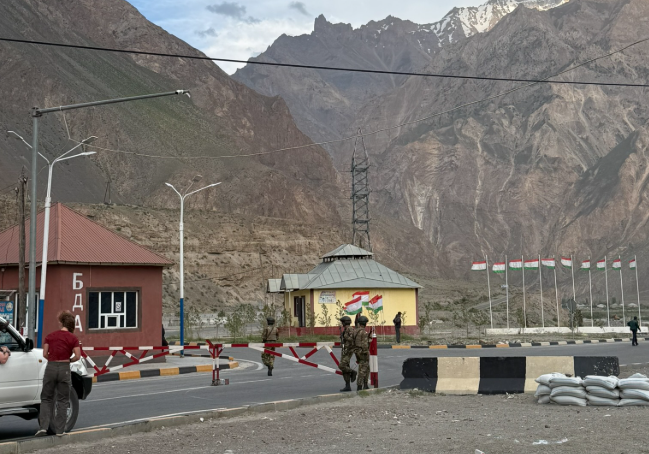
GBAO sounds intimidating before you go. It’s a restricted autonomous oblast requiring a government permit to enter, bordering Afghanistan and China, sitting at the edge of the map in every sense. The kind of place your family Googles while you’re packing and then calls you about.
In practice, the GSR handles the permit. You don’t navigate Tajik bureaucracy yourself. You show up, you run, the paperwork has been sorted. One less thing.
The jeeps are with you the entire route, every leg, every day. If something goes sideways, you flag one down. I shamelessly jumped into the jeeps a few times when my legs (and stomach) started conspiring against me. The prefect respite to recover a little without falling behind.
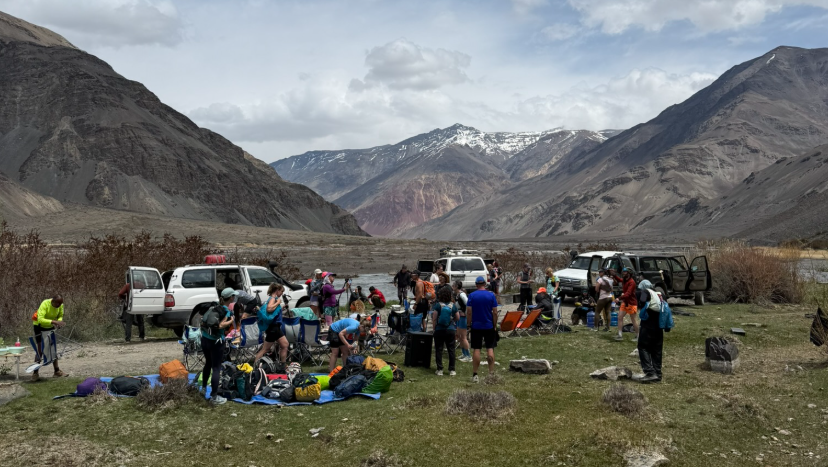
The support team carries a medical kit that would make a small clinic jealous, and the embedded medics know how to use all of it. Altitude sickness, blisters, a rolled ankle, a stomach staging a full rebellion… none of it requires improvisation. The safety net is real and it’s close.
Then there are the people. The villages along the Bartang valley are remote by any measure, and the locals are among the most welcoming you will encounter anywhere. Homestays aren’t just logistical solutions. They’re the trip. Families opening their homes to thirty sweaty foreigners, feeding them, letting them sleep on their floors, waving them off in the morning. The warmth is genuine and it catches you off guard every time.
GBAO intimidates on paper. On the ground it takes care of you. That gap between expectation and reality is one of the better surprises the GSR has to offer, and it frees up a lot of mental bandwidth for everything that comes next.
Community: 30 Strangers, One Speaker, Zero Personal Space
The GSR group skews British, with a scattering of Americans and other nationalities mixed in. Everyone has a backstory. Everyone is immediately, almost suspiciously, willing to have a real conversation with people they met thirty-six hours ago.
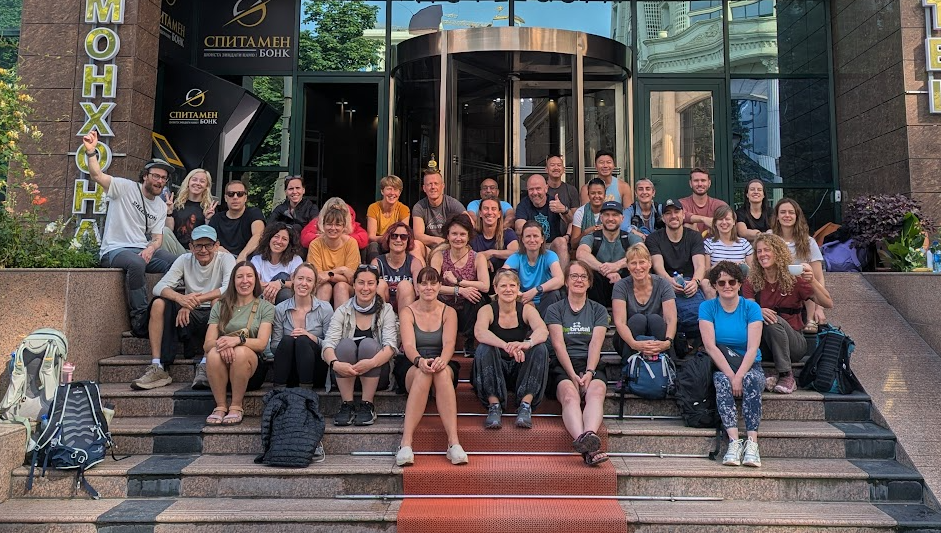
This is what happens when you drop a pile of strangers into shared physical difficulty somewhere with no distractions. The usual social scaffolding, the small talk, the careful professional positioning, the slow accumulation of trust over months, collapses. You skip straight to the real stuff, mostly because there’s nothing else on offer.
The running format helps. Three legs a day creates natural rhythms of grouping and regrouping. You fall in alongside someone for a few miles, get into something genuine, then peel off for a solo hour when you need to be inside your own skull. No obligation to perform sociability for seven straight days. The social battery charges and drains on its own schedule.
There are two designated vibe makers on the trip whose entire apparent mandate is ensuring nobody’s energy flatlines. Pair that with the aforementioned refrigerator-speaker, which follows the group everywhere, and you get spontaneous dance parties at rest stops and music echoing across valley floors that have, in all likelihood, never previously encountered a playlist. On paper it sounds excessive. In practice it is exactly correct.
By the end of the first few days, thirty-plus strangers have congealed into something that functions like an immediate family. Loud, slightly feral, and genuinely glad to be in the same patch of Central Asian dirt at the same time. The GSR is designed to produce this outcome and it delivers reliably.
Esteem: Don’t Cash It Early
Here’s the catch with running an unrace: nobody tells your brain it’s an unrace.
For the first three days, my default mode is race brain. Not against the other humans, there’s no one to beat, but against the route itself. Against the camps. The unspoken goal becomes the next rest stop, the next lunch, the next horizontal surface. Reach camp. Reach camp. Reach camp, like a mantra nobody agreed to.
This is Esteem logic applied to the wrong timescale. The payoff at the end of the GSR is real. You crossed a country on foot through some of the most spectacular and inaccessible terrain in Central Asia. There’s a medal. You get to be insufferable about it at dinner parties for years. Nobody can repossess any of that. But when you start borrowing against that finish-line reward during the run itself, treating every checkpoint as a micro-podium to optimize toward, you quietly drain the experience of the thing that made it worth signing up for.
The casualties of race brain are small and accumulate. An impromptu volleyball game at a rest stop, skipped. A spontaneous swim when half the group hurls themselves into a roadside pond, passed on. Both times the calculation is identical and very responsible: conserve energy, stay focused, reach camp.
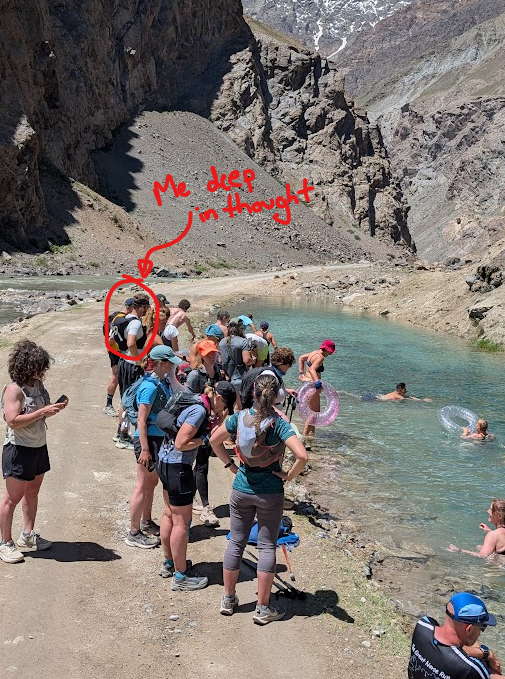
In retrospect, the volleyball game and the pond were the trip. The camp was just a necessity to meet the lower-level needs.
The antidote isn’t to ignore the finish. Finishing matters. The medal is real and the bragging rights are real and crossing Tajikistan on foot is not nothing. The antidote is recognizing that Esteem is a reward you collect at the end, not an operating system you run throughout. The GSR seems specifically engineered to teach you this lesson. I learned it somewhere in the middle of the week… the hard way.
Transcendence: Throw the Nugget
Back to Day 5.
Twenty-eight miles, 4,327 feet of climbing, nearly eleven hours of moving time. The beast day. The one where the route hauls you off the valley floor and onto the high Pamirs with no particular sympathy. And somewhere in the middle of it, a cold front rolled in fast. Temperature dropped. Wind picked up and brought all its dust with it. The landscape, which had been gradually trading green for something more lunar, went from merely desolate to openly hostile.
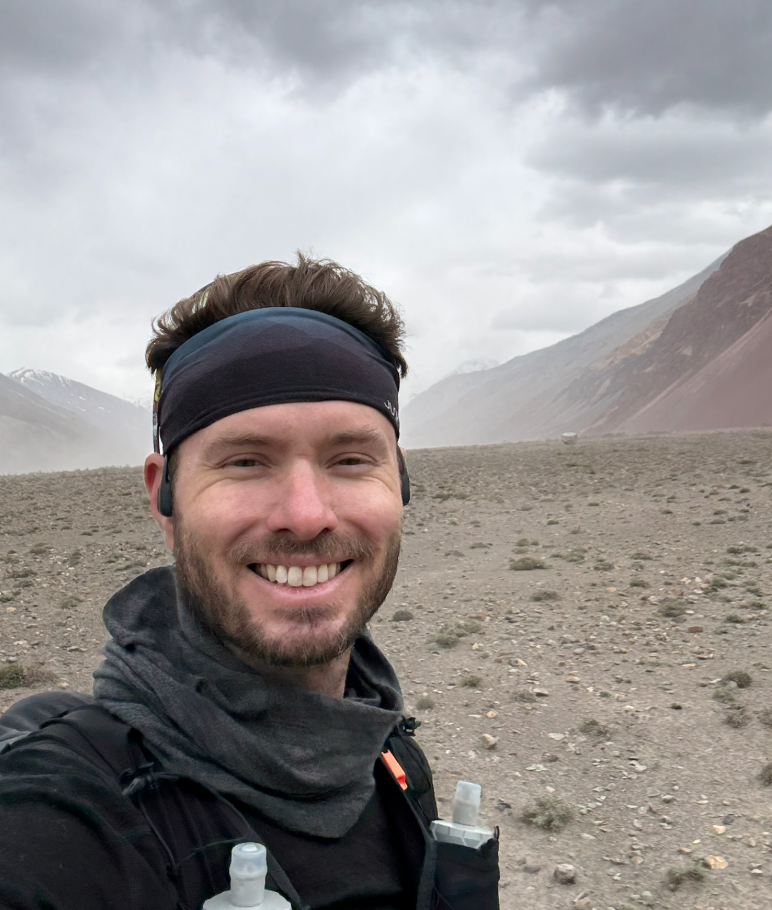
So: everything goes on. Rain pants over the tights, jacket over the layers, buff up over the face, gloves. Sealed head to toe, shuffling through a dust storm in what was, objectively, a very committed costume. And there it was: the feeling of being a kid playing outside in weather he was explicitly told to stay out of. Fully present, vaguely ridiculous, going nowhere in particular except forward.
That’s when it landed.
The GSR gives each participant a small wooden nugget to throw at a moment that feels right. Somewhere in that dust storm, cocooned in rain gear with Afghanistan somewhere behind and China somewhere ahead, I threw mine. Into the wind. Into the absurdity. Into the specific texture of that exact moment, which was not going to be improved by reaching camp any faster.
The point was never the next camp. It was this. The cold front and the dust and the idiotic layers. The Bartang opening up below on the green, sweltering early days. Day 5’s 4,300 feet of climbing, which does not ask your permission and does not accept negotiation. The high plateau thinning out into something that reads less like scenery and more like atmosphere you can stand inside. Karakul at the end, with the Pamir Highway finally visible, a road that had existed in my planning for months, now just something I was arriving at without any urgency whatsoever.
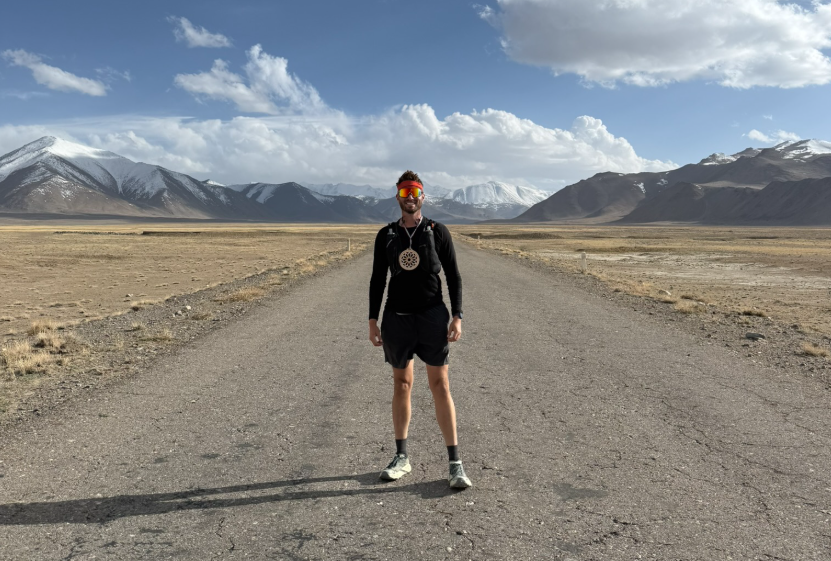
The unrace format is not an accident. By removing competition, it removes the most powerful gravitational pull keeping you anchored at Esteem. With nothing left to optimize for except the experience itself, the hierarchy does what it’s supposed to do. It keeps climbing, all the way to the top.
Coda: Bishkek and the Great Protein Reckoning
The expedition ends with a long drive from Karakul to Osh, Kyrgyzstan. After a parting group dinner, I fly to Bishkek to await my flight home. Four days in the Kyrgyz capital. I spent them accomplishing almost nothing of note and eating steak three separate times and hamburgers twice.
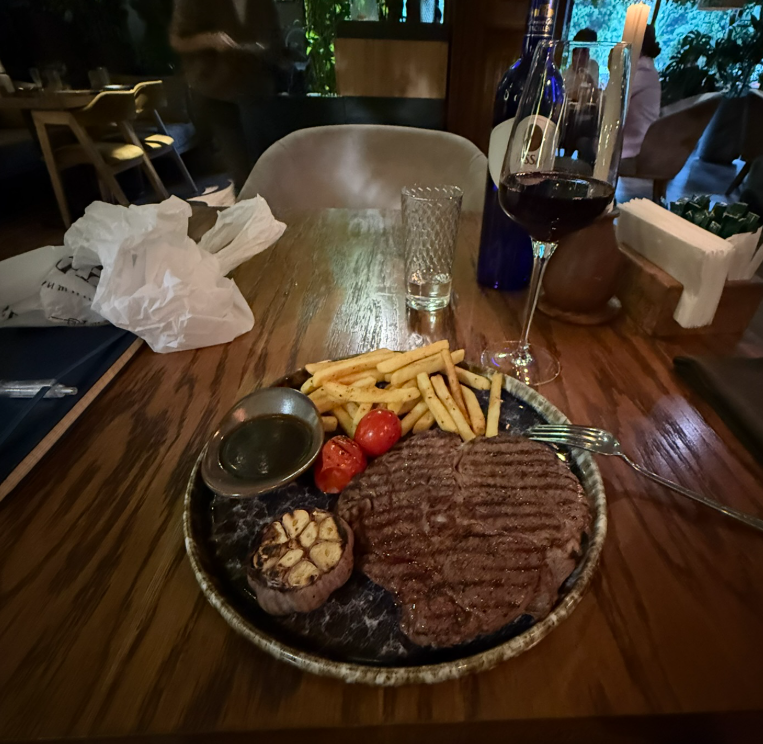
This is not a metaphor. After seven days of cold rice and structural carbohydrate dependence, Bishkek had restaurants and my body had a very specific agenda. The protein ledger was going to be balanced one way or another. One thing I overlooked in my packing: some non-athletic clothes suitable for the restaurant scene. I managed anyway.
What the GSR leaves you with, beyond the medal and the sunburn and the faint volleyball-shaped regret, is a sharper version of something adventurers suspect but rarely get forced to confront: the experience is most fully itself when you stop trying to get to the end of it. The hierarchy isn’t just a taxonomy of what hard trips give you. It’s a map of what opens up the moment you stop borrowing against the finish line.
The Great Silk Run is built to take you there whether or not you showed up ready for the lesson. The unrace does its job. The dust storm does its job. And eventually, so does the nugget.
Go throw yours.
5 responses to “The Great Silk Run: Crossing Tajikistan with Maslow as My Pacer”
Yaaaaaassssss!!!!!
Sean this is beautiful and so evocative!! Thank you for sharing this 💛
Sean this is a beautiful recollection of the trip!
Brilliantly captured Sean 👏
Sean,
My daughter passed this on to me.
“A friend of mine from the Tajikistan trip wrote this about our experience and it’s stunning. I thought you’d like it.”
Boy, was she right! It’s beautifully written and is so descriptive that even if I hadn’t heard about this trip from Anna, I would feel like I’m right there. You really did a fantastic job!
Thanks for your incredibly well written account of an epic adventure!
Throw the nugget👏🏽